
The Wild History of 1970s Bootleg T-Shirts and What They Teach Us About Merch Today
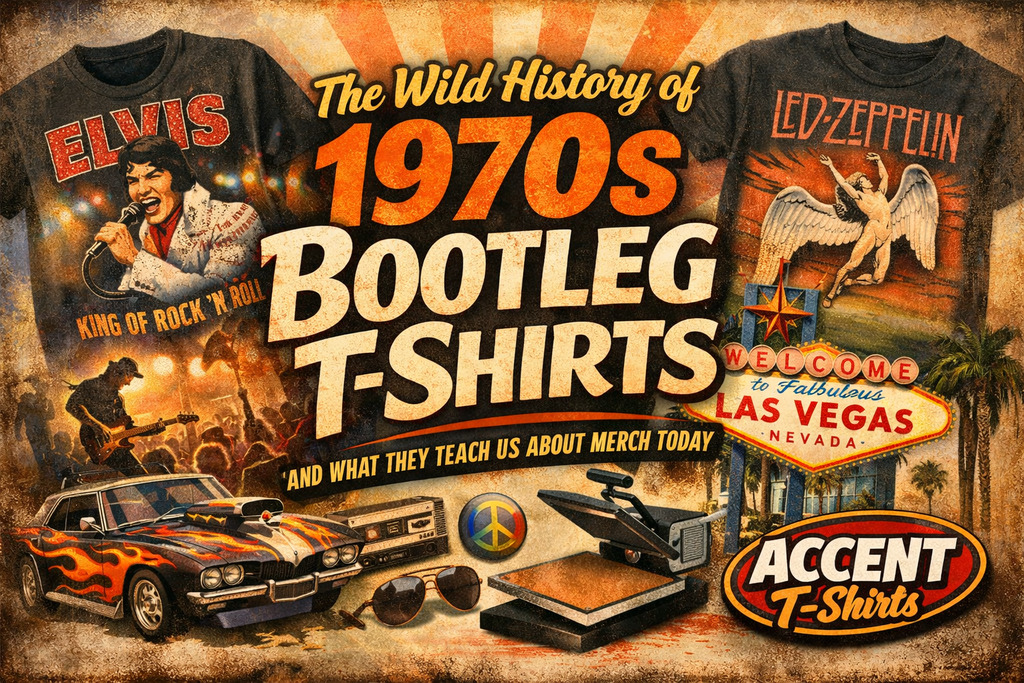
here is something great about a shirt that was never supposed to become part of fashion history.
It was not approved by a brand team. It did not come out of a polished merch strategy meeting. It did not go through six rounds of corporate revisions. It was made fast, sold fast, and usually printed because somebody saw an opportunity. A crowd was gathering, demand was obvious, and people wanted something they could wear home that night.
That is a big part of what made 1970s bootleg T-shirts so interesting.
When people talk about vintage tees today, they often picture faded concert shirts, souvenir prints, ringer tees, iron-on transfers, weird tourist graphics, soft old cotton, cracked ink, and slightly off-center designs that somehow feel cooler than anything overly perfected. A lot of that energy came from unofficial shirt culture. Bootleg shirts lived in parking lots, flea markets, boardwalk shops, swap meets, souvenir stands, and tiny local print setups. They were rough around the edges, but they were real. They connected directly to music, sports, tourism, movies, and regional identity in a way that still shapes custom apparel now.
For a modern custom apparel shop, there is a lot to learn from that era. The 1970s were not just a decade of strange graphics and wild fonts. They were also a lesson in how people emotionally connect with merch. A shirt did not have to be perfect. It had to feel current, wearable, memorable, and connected to something people cared about.
That still matters now.
At Accent T-Shirts, we spend a lot of time thinking about why some custom shirts get worn once and forgotten while others become favorites. The history of 1970s bootleg T-shirts is a surprisingly good place to start, because it shows how strong design, timing, identity, and culture can turn a simple printed shirt into something people keep for years. Whether you are building merch for a band, event, local business, convention booth, fundraiser, or brand, a lot of the old rules still apply.
What “bootleg” meant in the 1970s
Today, the word “bootleg” gets used loosely. Sometimes people use it to describe parody designs. Sometimes it means unofficial merch. Sometimes it refers to reworked vintage styles or shirts inspired by old parking lot concert tees. But in the 1970s, bootleg usually meant something direct: shirts made and sold without official licensing or approval.
These were not always part of some huge underground operation. In many cases, they were small-batch products made by quick-thinking printers, local sellers, street vendors, and independent entrepreneurs who realized that demand for pop culture shirts was growing faster than official merchandise channels could keep up.
That mattered because the 1970s were a perfect storm for shirt culture.
Music was huge. Arena concerts were growing. Touring acts had massive followings. Sports fandom was becoming more visible in everyday clothing. Vacation shirts and city souvenir shirts were everywhere. Screen printing equipment was more accessible than before. Iron-on transfers had become a major consumer trend. The T-shirt itself was no longer just an undershirt. It was turning into a billboard, a souvenir, a flex, a memory, and a form of self-expression.
Official merch was still developing as a real business category. In many cases, demand outran organization. If a major concert hit town and thousands of people wanted a shirt, there was money to be made. If a local tourist strip had nonstop traffic, somebody was going to sell graphic tees. If a movie, TV show, or celebrity suddenly caught fire, unofficial designs could appear almost overnight.
That is the part people still love. Bootleg shirts reflected speed. They reflected hustle. They reflected people reacting to culture in real time.
Why the 1970s were such a big decade for graphic T-shirts
To understand the rise of bootleg shirts, it helps to understand what changed about T-shirts in general during that decade.
By the 1970s, the T-shirt had become casual outerwear. That sounds obvious now, but it was a major shift. People wore printed tees to concerts, beaches, amusement parks, bars, road trips, political events, schools, and neighborhood hangouts. Shirts became communication tools. They said what band you liked, where you went, what city you loved, what joke you got, or what scene you belonged to.
A few things pushed that forward.
First, printing got more democratized. Screen printing was still a craft, but it became more available to local shops and small operators. Heat transfer and iron-on culture also exploded. That created a wave of personalized and fast-turn shirts that felt different from traditional retail.
Second, youth culture and counterculture fed demand. People wanted graphics that felt less corporate and more immediate. That opened the door to unofficial merch because it often felt rawer, more specific, or more rebellious than official products.
Third, tourism and destination culture were huge. If you visited Las Vegas, Los Angeles, Hawaii, New York, Disney-adjacent spots, national parks, beach towns, or highway roadside gift shops, graphic shirts were everywhere. The souvenir shirt became its own world. Some were official. Plenty were not.
Fourth, music merch started becoming a bigger deal, but the infrastructure was still loose enough that outside sellers could thrive. Parking lot shirt culture became legendary for a reason. People often bought what was available, affordable, and visually exciting in the moment.
That environment created a golden era for all kinds of strange and memorable shirt graphics. Some were loud. Some were sloppy. Some were weirdly brilliant. And some became design references for decades afterward.
The likely answer to “what was the biggest bootlegged T-shirt of 1975?”
There is not one clean, provable single winner.
That is the honest answer.
If someone asks for the biggest bootlegged T-shirt of 1975, it is hard to identify a single design with certainty because bootleg production was scattered, local, poorly documented, and often intentionally unofficial. A lot of these shirts were not cataloged by brands or licensed merch companies. They were sold hand to hand, city to city, venue to venue, often with endless variations.
But if you ask a better question — what kinds of shirts were probably among the most bootlegged in the mid-1970s? — you start to get somewhere interesting.
The strongest candidates would likely include:
- major rock concert shirts
- Elvis-related souvenir and fan shirts
- tourist destination shirts
- hot rod, biker, and race-inspired shirts
- movie or TV-inspired novelty shirts
- iron-on slogan tees
- local event and fair shirts
- sports fan shirts made outside official licensing
In practical terms, the “biggest bootlegged shirt” of that period may not have been one exact art file. It may have been a category: the unofficial concert tee, the destination souvenir tee, or the novelty transfer shirt.
That is part of what makes the question good for a blog. The mystery is not a weakness. It is the story.
Concert shirts may have been the kings of bootleg culture
If one category deserves the most attention, it is probably concert shirts.
By the 1970s, rock music was not just popular. It was lifestyle-defining. Fans wanted something physical to take home from a show. The shirt made perfect sense. It was affordable compared with jackets or other memorabilia, easy to carry, easy to wear, and visible. It let fans signal identity long after the concert ended.
But official merch systems were often inconsistent. Some tours had merch programs. Some had limited offerings. Some had weak designs. And some simply could not meet the intensity of demand around big artists. That created an opening.
The unofficial concert shirt became a parallel merch economy.
These shirts might feature hand-drawn art, rough portraits, tour-inspired text, city names, fake dates, or designs that looked close enough to official branding to sell quickly. Some were obviously off-brand. Others were good enough that buyers barely cared. And some fans may have even preferred the unofficial version because it felt more underground, cheaper, or just cooler.
This is where modern merch brands still take inspiration. The parking lot shirt had energy. It was made to hit immediately. It was not built around a polished corporate brand manual. It was built around emotion, fandom, and speed. Many of today’s vintage-style band tees, washed graphics, oversized prints, distressed inks, and retro type choices are still borrowing from that feel.
For a modern merch strategy, that does not mean copying bootlegs. It means understanding why they worked. They worked because they captured the moment better than a safe, generic design.
Tourist shirts were probably even bigger than people realize
Another major contender for “most bootlegged” would be tourist and city shirts.
Think about what happened in the 1970s when destination travel, roadside culture, gift shops, casino tourism, and regional identity all mixed together. You had millions of visitors wanting a wearable souvenir, and T-shirts were one of the easiest products to produce. This created a massive market for city-name tees, skyline shirts, beach graphics, motel humor shirts, desert imagery, western souvenir shirts, and novelty destination designs.
Las Vegas is a great example. The city has long been a natural home for graphic souvenir culture. Neon, casinos, lounge acts, road trips, desert kitsch, and bold visual language all make the city perfect for shirts. Official versions always existed, but so did countless unofficial or loosely sourced souvenir prints. They might not have been “bootleg” in the same sense as a fake concert shirt, but they lived in the same world of fast-moving, opportunistic graphic production.
These shirts mattered because they taught merch makers something simple: people do not always buy a shirt because it is official. They buy it because it captures the place, the mood, or the memory.
That idea still works today. Businesses in Las Vegas, especially those doing event merchandise, convention shirts, local brand merch, or retro city-inspired designs, can learn a lot from old tourist tees. A strong location-based shirt still sells because it gives people a story they can take home.
Iron-on culture changed everything
No conversation about 1970s shirt culture is complete without iron-on transfers.
For a while, iron-on graphics were everywhere. People bought pre-made transfers in stores, at kiosks, in catalogs, and at tourist spots. They could choose from jokes, names, zodiac signs, travel themes, cartoon-style graphics, innuendo, and every type of novelty slogan imaginable. This was personalization before modern print-on-demand platforms.
Iron-ons mattered because they made shirt customization faster, cheaper, and more decentralized. A person did not need a huge printing operation to sell graphic shirts. In some cases, they just needed blank tees, heat equipment, and the right transfer stock. It was an easier entry point into the shirt business, which meant more experimentation, more weirdness, and a lot more unofficial production.
Some iron-on shirts were not exactly “bootlegs,” but they lived right next to bootleg culture. The line between novelty shirt, parody shirt, souvenir shirt, and unofficial graphic tee was often blurry. That looseness helped build the broader graphic T-shirt economy.
It also taught a lesson that still applies now: fast customization sells.
Modern DTF printing, DTG printing, and other short-run methods succeed for some of the same reasons iron-ons once did. People want flexibility. They want design variety. They want full color. They want smaller runs without committing to huge inventory. The technology has changed, but the demand pattern feels familiar.
Why vintage bootleg tees still look cool now
A lot of people love 1970s-style shirts because they feel human.
That might sound strange, but it is true. Old bootleg and unofficial shirts often have imperfections that make them better. The art may be awkward. The colors may be slightly off. The type might be stretched, curved, cramped, or oversized. The graphic placement might feel a little too high or too bold. The print may crack over time. The cotton may fade. But all of those things create personality.
Modern design often gets cleaned up too much. It becomes technically polished and emotionally forgettable.
Vintage bootleg shirts were the opposite. They had attitude. They looked like someone made a decision and ran with it. The best ones feel confident, immediate, and specific. They are not afraid of giant graphics, weird color combinations, or humor that lands in one second.
That is part of why retro-inspired merch still works so well now. A shirt can feel fresh when it borrows the energy of old designs without becoming a copy. Bold chest prints, oversized back graphics, vintage type, mascot illustrations, one-color art, cracked textures, destination themes, and hand-drawn layouts all owe something to older graphic tee culture.
For businesses and brands, the takeaway is simple: people want shirts that feel alive.
What modern custom apparel can learn from 1970s bootleg shirts
There are real business lessons in all this.
If you strip away the licensing issues and focus on why the shirts connected, a few patterns become obvious.
1. Speed matters
Bootleg culture thrived because it reacted quickly. People were not waiting six months for the perfect rollout. They were making shirts when interest was hottest. Modern brands still benefit from that. Event shirts, limited merch drops, timely cultural references, and fast turnaround all matter because excitement fades fast.
2. Identity sells better than decoration
The best old shirts did not just “look nice.” They represented membership. A concert fan, a tourist, a local, a biker, a team supporter, a partygoer. The shirt let people wear identity. That still wins over generic designs.
3. Simplicity is powerful
A lot of old shirts were direct. Big text. Bold imagery. One strong idea. They did not over-explain themselves. That is useful now when designing merch for events, staff, conventions, or brands that need immediate impact.
4. Imperfection can feel authentic
Not every shirt needs to look sterile. Sometimes slightly rougher illustration, vintage distress, hand-drawn type, or a more relaxed design approach creates a stronger emotional connection.
5. Place matters
City shirts, regional shirts, and destination graphics worked because they made geography part of the appeal. Businesses in Las Vegas especially can use this well. Local flavor is not a limitation. It is a strength.
6. Wearability matters more than novelty alone
Some old novelty tees were funny for five minutes. The ones that survived were the ones people actually liked wearing. The lesson is to make shirts that balance concept with comfort and style.
The connection between vintage shirt culture and modern event merch
A lot of what people now call “event merch” has roots in old shirt culture.
Concert shirts were event shirts. Tourist shirts were event shirts. Fair shirts, race shirts, souvenir shirts, and team shirts were all tied to a moment. They acted as proof that someone was there, part of it, or connected to it. That is still the job of many modern custom shirts.
Think about conventions, trade shows, company retreats, fundraisers, school events, music festivals, reunions, product launches, and community gatherings. People still want the same basic thing: a shirt that helps mark the moment. That does not mean every shirt has to be oversized and vintage-looking, but it does mean the emotional logic has not changed much.
A good event shirt should feel worth keeping.
That sounds simple, but a lot of event shirts fail there. They become overly sponsor-heavy, too generic, or designed only for committee approval rather than actual wear. Vintage bootleg culture reminds us that the shirt itself should be desirable.
At Accent T-Shirts, that is one of the biggest design questions we like asking: would someone wear this again? If the answer is yes, the shirt is doing more than advertising. It is becoming part of somebody’s rotation.
Why retro-inspired shirt design works for businesses too
It is easy to think of vintage-inspired shirts as something only bands or lifestyle brands should use, but local businesses can benefit from that design language too.
A company shirt does not have to look stiff. A restaurant tee, bar shirt, brewery design, coffee shop shirt, tattoo shop merch piece, auto shop tee, construction company shirt, nonprofit fundraiser shirt, or staff event shirt can all take cues from retro bootleg energy. Not illegally, and not by copying anyone else, but by using the same principles: strong art, memorable type, good placement, clear identity, and something people actually want to wear.
This is especially effective in a place like Las Vegas, where visual style matters. Retro neon, desert themes, vintage sign influence, western typography, casino-era color palettes, old-school souvenir energy, and tourism culture all fit naturally into shirt design.
A lot of the best branded merch now works because it feels less like a uniform and more like a shirt somebody would choose on purpose.
That is a very 1970s lesson.
From bootleg attitude to modern print methods
The production side has changed a lot, but the mindset is still recognizable.
In the 1970s, people used the tools they had: screen printing, transfers, hand-drawn separations, quick local production, simple blanks, fast improvisation. Today, shops have more options. Screen printing is still king for many runs. Embroidery handles a different category of decorated apparel. DTF printing brings flexibility and full color. DTG handles detailed art and smaller runs on cotton garments. But the real question remains the same: what is the fastest, smartest way to turn a good idea into a shirt people want?
That question links old bootleg culture to modern print shops more than people realize.
The difference now is that a professional local shop can deliver speed and creativity without the chaos. A business does not have to choose between energy and quality. It can have both. That is where modern custom apparel should beat the old parking lot version every time.
You can keep the boldness, the nostalgia, the identity, and the immediacy while still getting better garments, better print quality, better consistency, and better brand presentation.
How to use vintage inspiration without making a shirt feel dated
Not every shirt should look like it was found in a cardboard box at a flea market. The goal is not to force nostalgia onto every project. The goal is to understand what makes vintage-inspired graphics appealing.
A few things usually help:
Use fewer ideas, but make them stronger.
Choose one central concept and commit to it.
Let the typography carry real personality.
Use layout boldly instead of timidly.
Think about softness and wearability, not just graphic impact.
Consider one-color or limited-color art when it makes sense.
Use texture carefully, not automatically.
Let location, event, or identity shape the design.
Keep the shirt wearable beyond the day it is handed out.
That last point matters a lot. Many businesses want custom apparel that feels promotional without looking disposable. Vintage culture gives good clues. If a shirt looks like real merch instead of a giveaway, people wear it more. If they wear it more, it works harder.
Why this topic matters for a Las Vegas print shop
Las Vegas is one of the best places in the country to think about merch culture.
The city sits at the intersection of tourism, entertainment, events, nightlife, conventions, local business branding, and spectacle. That means shirts here do not only serve one purpose. They can be souvenirs, uniforms, merch, conversation starters, booth giveaways, local brand pieces, or event keepsakes. The city has always had strong visual identity, and that makes it a natural fit for retro-inspired apparel thinking.
A local print shop in Las Vegas has an opportunity to do more than simply put a logo on a shirt. It can help clients make something memorable. It can take lessons from old souvenir culture, old concert culture, old race culture, old neon sign culture, and old western desert graphics and turn them into modern wearable pieces.
That is why the history of 1970s bootleg shirts is not just trivia. It is useful design history. It reminds us that the best shirts connect instantly and emotionally.
What clients should think about before creating vintage-inspired merch
If you are planning a custom shirt and want that older, collectible kind of energy, a few questions can help.
What moment or identity is this shirt representing?
Would someone wear this casually, not just out of obligation?
Is the design bold enough to be memorable?
Does the artwork feel too safe?
Would this look better with fewer elements?
Is this built for an audience or for committee approval?
Could this use a stronger sense of place, event, or attitude?
Would the print method support the visual style well?
Those are good questions whether the shirt is for a brand launch, local bar, convention booth, fundraiser, school event, band drop, or company merch run.
The real legacy of the 1970s bootleg T-shirt
The legacy is not counterfeiting. The legacy is cultural responsiveness.
The best shirts from that world responded to what people cared about right then. They were fast, bold, specific, wearable, and emotionally connected. They understood that a shirt could carry memory and identity better than most cheap souvenirs. They understood that people wanted to wear something that made them feel like they belonged to a scene, a city, a night, or a moment.
That is why so many old unofficial shirts still feel alive. They did not just decorate fabric. They captured energy.
Modern custom apparel still works best when it does the same thing.
Whether you are building company merch, event shirts, convention apparel, destination-themed designs, restaurant staff shirts, local brand pieces, or a retro-inspired graphic line, the same lesson applies: the shirt has to mean something to the person wearing it.
That was true in 1975. It is true now.
Final thoughts: what 1970s bootleg shirts still teach us
So, what was the biggest bootlegged T-shirt of 1975?
Maybe it was a concert shirt. Maybe it was a city souvenir tee. Maybe it was an Elvis graphic, a novelty transfer, or a race-inspired shirt sold out of a trailer, kiosk, boardwalk stall, or parking lot. We may never get a single final answer.
But maybe that is the wrong thing to chase.
The better story is that the 1970s created a shirt culture where unofficial designs could become iconic because they moved fast, felt real, and connected deeply. They were proof that custom apparel is not just about ink and cotton. It is about timing, identity, place, style, and memory.
That is still the formula.
At Accent T-Shirts, we love that part of the apparel business. A good shirt should not feel throwaway. It should feel worth keeping. Whether you want vintage-inspired custom t-shirts, event shirts, branded merch, promotional apparel, or a design that feels more like real merch and less like generic swag, the goal is the same as it was decades ago: make something people actually want to wear.
And when that happens, the shirt lasts longer than the moment that inspired it.
If you need custom t-shirt printing in Las Vegas, retro-inspired merch design, event apparel, branded company shirts, or local help bringing a great shirt idea to life, Accent T-Shirts is here to help.
Written by Lindy Williams, Owner of Accent Promotions and Media, Accent T-Shirts, and Race Day Outfitters. Based in Las Vegas, Lindy specializes in custom apparel, screen printing, embroidery, DTF printing, DTG printing, promotional products, convention merchandise, and branded apparel for businesses, events, and teams.